The Complete Guide to Product Enrichment (2026)
What product enrichment is, why it matters, and how to build accurate, searchable product catalogs — matching, validation, identifiers and workflows.
Every e-commerce business eventually runs into the same problem: product data arrives incomplete, inconsistent, or simply wrong. Supplier spreadsheets contain abbreviated names, missing specifications, duplicate products, inconsistent categories, and little or no information that customers actually need to make a buying decision. As catalogs grow from hundreds to thousands of products, manually cleaning this data becomes expensive, slow, and difficult to maintain.
Product enrichment solves this problem by transforming raw product information into complete, standardized, and verified product records. Instead of relying on supplier data alone, enrichment combines information from trusted sources to produce accurate names, brands, product identifiers, descriptions, specifications, categories, and images. The result is a catalog that is easier to manage, performs better in search engines, and provides a better shopping experience for customers.
What is product enrichment?
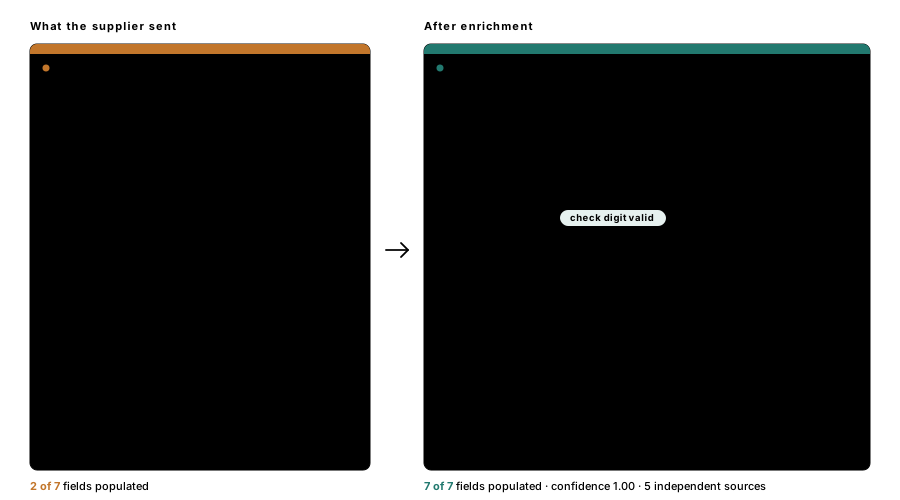
Product enrichment is the process of improving existing product data by adding missing information, correcting inconsistencies, and standardizing records across an entire catalog. Rather than replacing your existing data, enrichment builds upon it, filling gaps while preserving information that is already correct.
A typical supplier feed may contain only a short product title and an internal SKU. After enrichment, the same product can include a complete product name, manufacturer, EAN or GTIN barcode, category, specifications, marketing description, product images, and structured attributes that can be used for filters and search.
- Standardize inconsistent product names.
- Identify brands and manufacturers.
- Add EAN, GTIN, UPC, or other identifiers where available.
- Assign categories and product types.
- Generate or retrieve product descriptions.
- Add technical specifications and attributes.
- Include product images.
- Remove duplicate product entries.
The goal is simple: every product in your catalog should contain enough accurate information for customers, search engines, and internal systems to understand exactly what it is.
Why product enrichment matters for e-commerce
Product data influences almost every part of an online store. Customers rely on titles, specifications, images, and descriptions to compare products before making a purchase. Search engines use structured information to understand pages, while marketplaces often require complete attributes before listings can be published.
Incomplete product data creates unnecessary friction. Customers spend more time searching for information, product filters become unreliable, duplicate listings appear, and teams waste valuable hours manually researching missing details. Even a high-quality website cannot compensate for poor product information.
Well-enriched catalogs provide several long-term advantages:
- More informative product pages — complete specifications and images answer the questions that otherwise become support tickets or returns.
- Better internal search results — site search can only find products whose attributes actually exist in the data.
- Improved product filtering — a filter is only as reliable as the least-complete product it covers; enrichment closes those gaps.
- Cleaner imports into ERP and PIM systems — standardized records drop in without per-file mapping work.
- More consistent marketplace listings — required attributes are present before the marketplace rejects the listing.
- Less manual catalog maintenance — corrections happen once, at the data level, instead of page by page.
- Higher confidence across teams — purchasing, marketing and operations work from the same verified record.
Think of product enrichment as an investment in data quality rather than a one-time cleanup. New supplier feeds arrive continuously, so enrichment works best as an ongoing process instead of a single project.
How the product enrichment process works
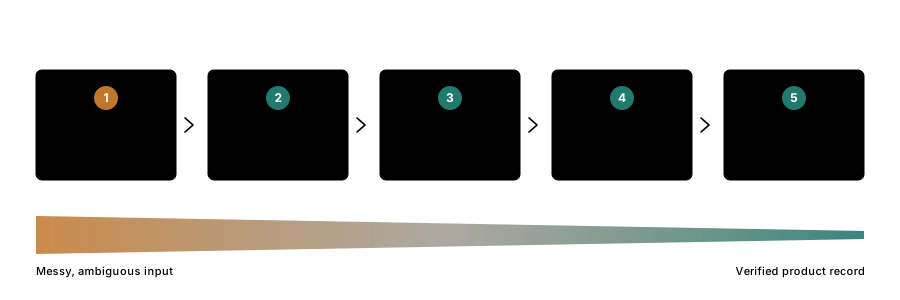
Most enrichment platforms describe the same five steps. What separates a reliable pipeline from a guessing machine is what happens inside each one — so here is the process as it actually runs, step by step, using ProductBox's own pipeline as the concrete example.
Step 1: Import existing product data
The process begins with whatever file your systems produce — a supplier price list, an ERP or POS export, a marketplace catalog. Formats and column names do not need to be standardized first: a good importer maps columns for you and asks rather than assumes, and per-list settings such as the export language are chosen here. The one thing worth doing before upload is keeping every column you have — brand, model number, price and even supplier name all become matching signals later.
Step 2: Identify the product
Identification starts by turning each messy row into something searchable. A language model decodes abbreviations, restores brand names and separates units from numbers — SGS24U 512 blk EU becomes a query with a brand, a model, a capacity and a colour. With a clean query, the pipeline searches the live web and collects several candidate sources per product: manufacturer pages, retailer listings, spec databases. Existing identifiers shortcut all of this — a valid EAN or GTIN resolves directly to one product, which is why recovering barcodes hidden in your file is the cheapest accuracy win available.
Step 3: Verify the match
Verification treats the best candidate as a hypothesis rather than an answer. Fields are cross-checked across at least two independent sources, and a variant guard compares capacity, colour, pack quantity and region against your original row — the 256 GB version must never pass for the 512 GB one. Every match receives a confidence score, and only results above 0.85 are accepted automatically. For the full walkthrough of the scoring and the failure modes it prevents, see how ProductBox matches product data.
Step 4: Add missing information
Once a product is verified, the surviving data from all sources is merged into one coherent record: standardized title, brand, EAN/GTIN, category path, description, structured specifications and images. Extraction filters out what web pages are full of — accessory listings, previous-generation spec tables, photos of the retail box — and your existing correct data is preserved, with only gaps and errors filled. Every attribute stays traceable to the source it came from.
Step 5: Review uncertain matches
Rows that fall short of the auto-accept threshold are not guessed. They land in a review queue where you see the full candidate record, can deselect individual images, specs or the description, and accept or reject in seconds. Rejected matches refund the credit almost entirely, and rows where nothing could be verified come back marked as no-match at no charge. The result set is honest by construction: accepted, review or no match — never silently wrong.
What makes accurate product matching difficult?
Many businesses assume product matching is straightforward until they examine their supplier data. Product names are rarely standardized, abbreviations vary between suppliers, and the same item may appear under several different descriptions.
For example, a supplier may list a smartphone as "SAMS GAL A54 128 CRN", while another source uses the complete product name with different capitalization, color naming, and storage formatting. Humans immediately recognize these as the same product, but computers require significantly more context.
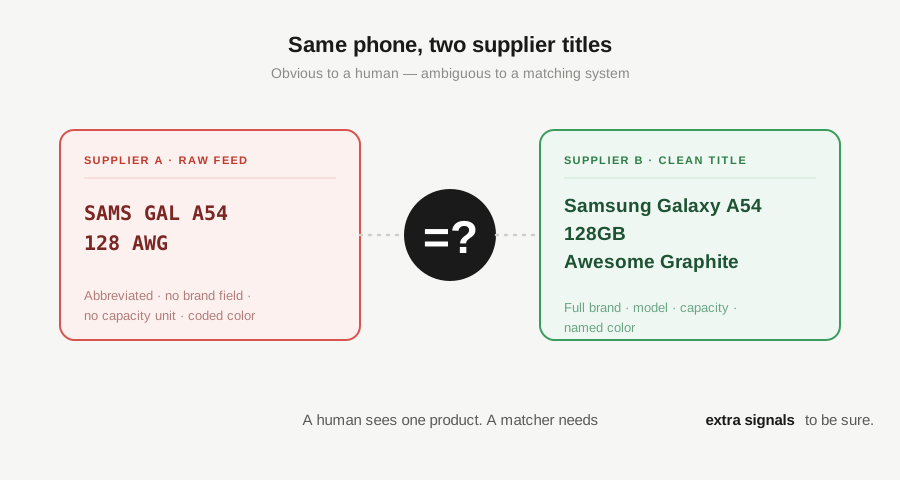
Several factors increase matching complexity:
- Abbreviated product names — SGS24U 512 tells a computer nothing until it is decoded.
- Missing manufacturer information — without a brand, every model number is ambiguous.
- Multiple languages — the same product described in German and Dutch shares almost no words.
- Regional product variants — EU and UK versions differ in plugs, packaging and sometimes barcodes.
- Inconsistent capitalization — BLK, Blk and Black scattered through one file.
- Different color naming conventions — a marketing name like Awesome Graphite versus plain grey.
- Missing identifiers — title-only rows force the system to infer from the weakest signals.
- Duplicate supplier records — one product under three article numbers looks like three products.
Modern enrichment platforms reduce these challenges by combining identifier matching, fuzzy text comparison, attribute extraction, manufacturer information, and confidence scoring rather than relying on exact text matches alone.
Whenever possible, include existing identifiers such as EANs, GTINs, manufacturer part numbers, or supplier SKUs in your imports. Even if some values are missing, the ones that are present can dramatically improve matching accuracy.
Best practices for building a high-quality product catalog
Product enrichment is most effective when combined with good catalog management practices. Even the best enrichment process benefits from consistent internal standards and clean source data.
- Keep one canonical product record for each product.
- Preserve existing identifiers whenever possible.
- Use consistent category structures.
- Standardize attribute names and units.
- Review uncertain matches before publishing.
- Remove duplicate products regularly.
- Maintain separate supplier-specific information where needed.
- Re-enrich products periodically as new information becomes available.
It is also helpful to distinguish between factual product data and marketing content. Technical specifications should remain structured and consistent, while descriptions can be optimized for readability without changing objective product information.
As catalogs grow larger, manual editing quickly becomes unsustainable. Automated enrichment combined with selective human review provides a scalable balance between speed and accuracy.
Choosing a product enrichment solution
Not every enrichment workflow is designed for the same use case. Before choosing a solution, consider how well it fits your existing catalog processes rather than focusing solely on the number of available features.
Questions worth asking include:
- Can it import CSV and Excel files?
- Does it verify product matches before enrichment?
- Can uncertain matches be reviewed manually?
- Does it preserve existing data?
- Can enriched data be exported in multiple formats?
- Does it support structured attributes?
- Is pricing based on successful results rather than uploaded rows?
- Can the workflow scale from hundreds to hundreds of thousands of products?
A practical enrichment workflow should reduce manual work without forcing teams to rebuild their existing systems. Flexible imports, transparent review processes, and clean exports are often more valuable than unnecessary complexity.
Takeaway: product enrichment is a long-term advantage
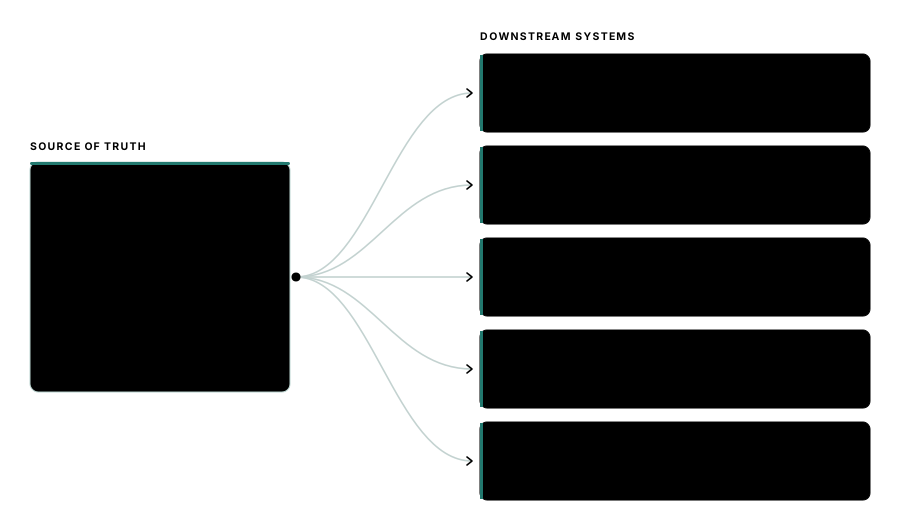
Product enrichment is more than adding descriptions or finding better images. It is the foundation of a reliable product catalog that supports better customer experiences, cleaner internal operations, and more efficient catalog management. Accurate product data benefits every downstream system, from webshops and ERPs to marketplaces and search engines.
Whether you're managing a few thousand products or hundreds of thousands, investing in consistent, verified product data reduces manual effort while making your catalog easier to maintain as your business grows. The earlier product enrichment becomes part of your workflow, the easier it is to keep your catalog accurate over time.
Frequently asked questions
What is product enrichment?
Product enrichment is the process of completing and correcting product data: adding verified names, brands, EAN/GTIN identifiers, categories, descriptions, specifications and images to records that arrive incomplete. It builds on the data you already have rather than replacing it.
What is the difference between product enrichment and a PIM?
A PIM stores and organizes product data; enrichment improves it. The two are complementary — enrichment cleans and completes data before it enters a PIM — but they are not interchangeable, and many catalogs need clean data more than they need another system to maintain. We compare the two in full in PIM vs product enrichment.
How much does product enrichment cost?
Pricing models vary: agencies bill by the hour, most software bills a subscription, and ProductBox bills per successfully enriched product — €0.06 to €0.09 depending on volume, with failed matches costing nothing. Done manually, the same work typically costs far more once research time per product is counted.
What data gets added during product enrichment?
Typically standardized product names, brand and model, EAN/GTIN barcodes, category paths, descriptions, structured specifications and product image URLs — each field traceable to its source, and exportable as CSV or JSON for webshops, PIM systems and marketplace feeds.
Ready to clean up your product list?
Upload a raw CSV or Excel file and get back verified names, EANs, categories, descriptions and images. First 25 products are free.
Get started free →